

Optionality is the new commitment
How we downgraded desire into a low risk political decision.


Something changed in the way we commit.
Not in the motivational poster sense but in the architecture of the decision itself.
We used to make choices that closed doors behind us and opened a new room in our life. Now we try to keep every door cracked open, just in case.
Love became a free trial. Politics became a month to month plan.
The moral ideal of the era is not courage or even consistency. It is optionality. The ability to exit without losses.
Desire dies in rooms full of emergency exits.
Return policies for the soul
We live inside an economy of reversibility. Almost everything can be returned, refunded, edited, deleted, unsubscribed from. You can undo a message and rewrite your self. You can keep fifteen versions of your identity in draft.
So the mind starts craving the same contract everywhere else.
We want relationships with a return policy. We want politics with a cancel button. We want intensity without consequence.
This is why our culture now loves the language of “boundaries” but often uses it like a firewall rather than a bridge. It is why “clarity” gets fetishized and why ambiguity feels like danger. It is why people do not say “I want you” as much as they think “I am assessing compatibility”.
The point is not that compatibility is bad.
The point is that assessment has replaced surrender as the default posture.
Emotional austerity
This is the part nobody wants to admit because it turns a personal story into a political one.
When wages stagnate, rents rise and work becomes a permanent audition, your nervous system rewires. You start treating any irreversible step as a threat. You learn that what looks stable can evaporate. You learn that institutions will smile while withdrawing support. You learn that the future is not promised and “plan B” is not paranoia. It is basic hygiene.
So you carry that logic into intimacy.
You choose the relationship least likely to collapse rather than the person who makes you feel alive. You stay because leaving feels like gambling with shelter. You tolerate emotional austerity because you already live in material austerity.
This is not romance failing because humans got shallow. This is romance reacting to economic conditions like any other organism reacts to a harsh climate.
The same applies to politics. When the world feels fragile, people stop demanding transformation and start demanding continuity and stability. Not because they love the status quo but because they fear the cost of disruption.
Democracy becomes a search for the least catastrophic option, not the most meaningful one.
The cult of “reasonable”
Every era has its sacred virtue. Ours is being reasonable.
Reasonable means measured. It means not asking for too much. It means knowing the limits of the possible. It means speaking in moderated tones and presenting your hopes as humble suggestions.
Yet “reasonable” is also the language that keeps people in underwhelming relationships and underwhelming political arrangements. It is the moral vocabulary of settling.
You can hear it in how people talk.
“I am not happy but it works”
“It is not ideal but it is stable”
“It is not what I wanted but it is what I can manage”
This is fear dressing up as virtue.
The funniest trick is that our culture frames desire as childish. Wanting too much is cringe. Caring too loudly is embarrassing. Protest is immature. Romance is naive. Vision is unserious.
Cynicism becomes a status symbol. Detachment becomes proof that you understand the world. The world then rewards you for being emotionally unavailable and politically resigned.
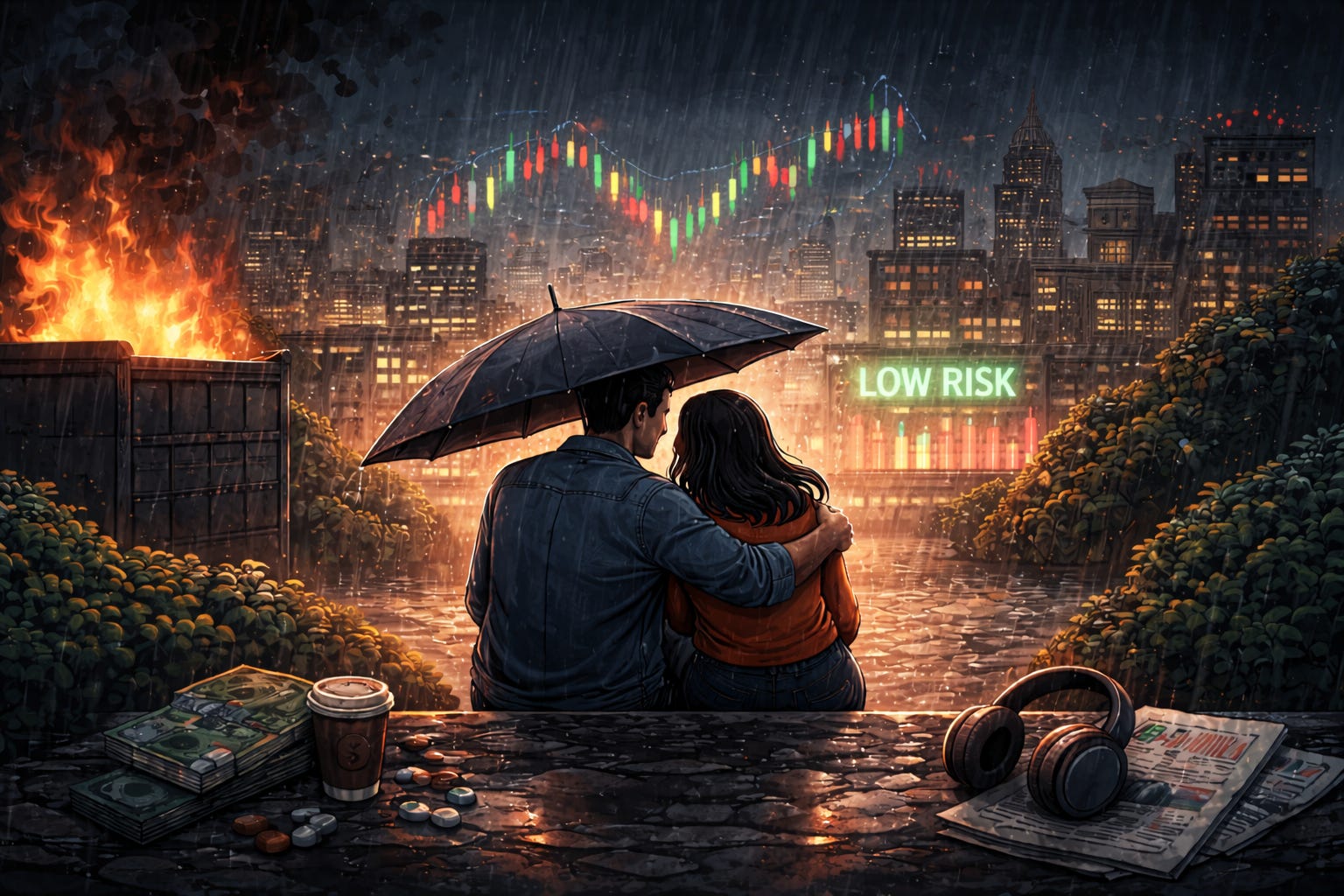
Love and politics as a hedge
In finance, hedging is what you do when you do not trust the future. You sacrifice upside to reduce risk. You accept a smaller life to avoid a collapse.
That is exactly how we now approach partners and political parties.
We do not choose what moves us.
We choose what seems least likely to explode.
We do not vote for the dream.
We vote for the hedge.
We do not build movements. We build coping mechanisms.
Even rebellion got domesticated. It is curated, monetized and posted in formats that cannot risk your job or your rent. Rage becomes content. Dissent becomes aesthetic. Politics becomes vibes with talking points.
Comfort culture completes the loop. It offers self improvement as a substitute for collective power. It tells you to regulate your nervous system while refusing to ask who keeps dysregulating it.
It does not fix the noise. It sells you noise cancelling headphones.
The paradox of safety
Safety is real. People need safety. The problem is what happens when safety becomes the only allowable aim.
A safe relationship can be a beautiful thing. A safe society can be a beautiful thing. But safety without desire produces a quiet form of death. The body stays alive and the spirit relocates.
The current culture is terrified of the risks that make love and democracy feel like life.
Love requires exposure. Democracy requires conflict. Both require the willingness to be disappointed without becoming submissive. Both require a tolerance for uncertainty and a taste for the unfinished.
When we eliminate uncertainty completely we do not get peace. We get management. We get a life that runs smoothly while meaning drains out through a small invisible leak.
It is the same logic Kafka mocked. The machine works perfectly and it still crushes you.
Less reasonable, more alive
The alternative is not chaos for its own sake. The alternative is to remember that some things are worth not being able to undo.
To love someone seriously is to accept that you cannot control the outcome.
To demand more from politics is to accept that you might lose.
To walk away from a stale relationship or a stale ideology is to accept the discomfort of the unknown.
That discomfort is not failure. It is the price of wanting.
A progressive politics worthy of the name does not promise comfort. It promises dignity. It promises that people can risk love and risk democracy because their basic lives are not one paycheck away from panic.
So yes, the cure is defiance. Not as a personality trait but as a practiced refusal to live only by hedges.
Less self optimization and more moral appetite.
Less “reasonable” and more alive.
The danger is not that our lives will collapse. The danger is that we will avoid collapse so successfully that we never build anything worth standing in.