Make Attention Great Again
The destruction of the attention span was not a side effect of the platform economy. It was the product all along.

We were sold a story about progress.
The infinite scroll was a feature.
The notification was a courtesy.
The algorithm was personalization.
Every interface designed to break a human mind into smaller, more sellable pieces was presented as a gift, handed out for free by innovators in fleece vests and sneakers who only wanted to connect the world.
The world is now connected and It cannot finish a sentence.
The smoke is exactly what this factory sells
The collapse of attention gets discussed, in the few serious conversations we still bother to have, the way we Athenians discuss the August heat.
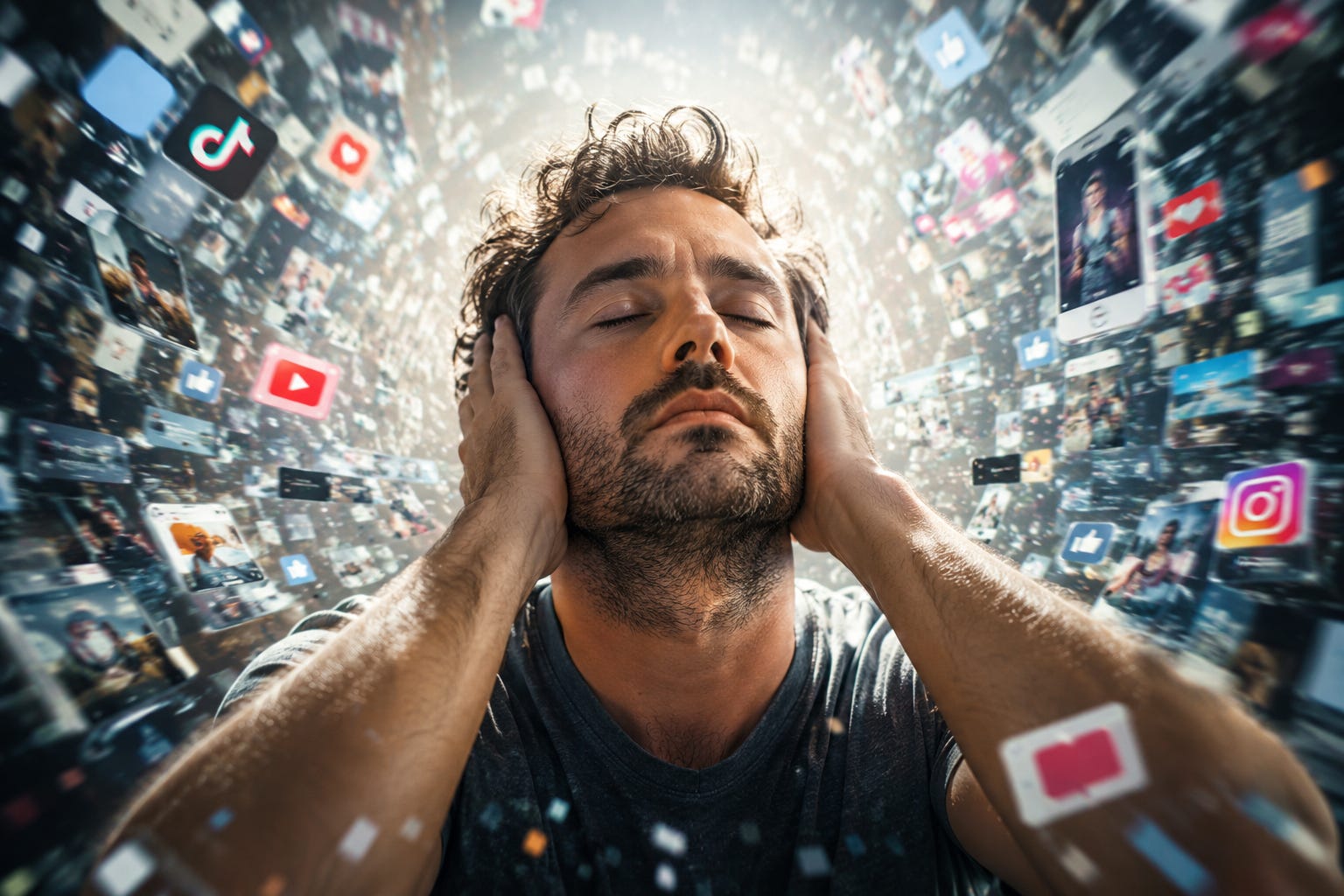
It simply happened to us. It blew in from somewhere offshore, the air went thick with TikToks and Reels and now we sit in it together, fanning ourselves with our phones, scrolling condolences to one another like neighbours on a balcony who have agreed that nothing can be done.
This way of talking is itself part of the problem.
It assumes that an industry making hundreds of billions of dollars by colonizing human minds produced this outcome by accident, the way a factory might accidentally produce smoke.
But the smoke is not the byproduct of this factory, it is exactly what this factory sells.
Attention is the only thing the platform economy actually produces.
Everything else, the videos, the posts, the friendships, the political movements, the genocides livestreamed and the cats falling off counters, is raw material.
The finished product is your fractured mind, packaged into measurable units of engagement and sold to whoever pays.
We now call this the attention economy, but that flatters it.
It is an inattention economy.
It thrives on the precise calibration of how little of yourself you can give to anything before reaching for the next thing.
Herbert Simon saw this coming back in 1971.
He wrote that “a wealth of information creates a poverty of attention”.
He thought of it as a problem of allocation, a market that would need to find its balance. He could not have imagined that the market’s solution would be to manufacture the poverty itself, deliberately and at industrial scale, because “poverty” was where the money was.
A reader who finishes an article is a reader who has stopped scrolling.
A citizen who thinks for ten uninterrupted minutes is a citizen who has stopped consuming.
Sustained attention is, from the platform’s point of view, theft.
Trump’s “genius” was metabolic
Look at what now passes for political life.
The clip replaces the speech.
The meme replaces the analysis.
The vibe replaces the program.
A serious policy proposal cannot compete with a thirty second video of a politician dancing badly, because the policy proposal asks for something the platform has trained us not to give.
The populist conservative Right figured this out before anyone else, which is why it now dominates the new terrain.
Trump’s genius, if i have to use that word, was never rhetorical.
It was metabolic. He matched the tempo of the feed.
His opponents kept writing position papers and wondering why nobody was reading them.
Gramsci wrote about cultural hegemony as the slow process by which a ruling class gets ordinary people to internalize its worldview.
He assumed this would happen through institutions, through schools and churches and newspapers, the long march of common sense.
He could not have anticipated that the most efficient hegemony would arrive through a device in your pocket, asking nothing of you except that you keep looking at it. The platforms do not need to tell you what to think. They only need to make sure you never think for long enough to form a thought of your own. Enter AI.
The oldest trick Capitalism plays
There is a particular cruelty in how all of this gets blamed on individuals.
“Put down your phone”, they say, as if the phone were a moral weakness rather than a billion dollar engineering project specifically designed to defeat your willpower.
”Read a book”, they say, in the same tone they might use to recommend cold showers.
The implication is that the inability to focus is a character flaw, fixable through discipline.
This is the oldest trick capitalism plays on its casualties.
Make the structural feel personal.
Convince the worker that his exhaustion is laziness, the debtor that his debt is irresponsibility, the doomscrolling citizen that his fractured mind is his own fault.
I have to admit that as someone whose brain was wired for stimulation long before TikTok existed, I may be unusually qualified to recognize a trap designed for people like me. ADHD is not the cause of this problem. But it makes the hook easier to feel. I know how quickly instant novelty can become a habit and how easily a platform can turn distraction into comfort.
So I have learned to be suspicious of any environment that rewards me too easily.
The platforms reward all of us too easily. That is the entire point.
A public health crisis
What would it mean to take attention seriously as a political question, instead of a wellness one?
It would mean treating the engineered destruction of human focus as the public health crisis it actually is, on the level of leaded gasoline or tobacco advertising. We eventually banned both of those, not because individuals lacked willpower, but because we recognized that some products should not be sold in some ways. It would mean breaking the business model, not patching it.
Algorithmic feeds optimized for engagement are not reformable, any more than a slot machine is reformable. The mechanism is the harm.
It would also mean slowly, against the current, rebuilding the institutions that used to train sustained attention.
Schools that demand long reading.
Newspapers that demand long writing.
Public spaces that demand long conversation.
Don’t get me wrong, none of this is nostalgia of a GenX.
The ability to pay attention is not a luxury of a vanished century.
It is the precondition of every freedom we still claim to value, and we are losing it on a schedule.
We are not the customers
Let’s be honest for a minute, we are not the customers of the platforms.
We are their inventory.
The customers are the advertisers, the political operatives, the foreign states and anyone else willing to pay for a few seconds of our mental real estate.
For two decades we have been told that the user is king. The user is the field being harvested.
Making attention great again, to borrow a phrase from the people who understood the new terrain most effectively, is not a matter of personal discipline.
It is a matter of political will.
It requires us to name what has been done to us and to name who has profited from it.
It requires us to remember that a mind capable of finishing a thought is not a quaint inheritance from “better times”.
It is the minimum equipment of a free person.